
For India and Indians, gold has mythological, historical, economic, social and
cultural significance. There are references to gold in the ancient Indian scriptures
and literature.
Gold’s economic significance as a store of value, financial security it offers and its
easy fungibility or exchangeability with cash are traits well recognized.
We have been the world’s second-largest importer and consumer of gold for many
years. Out of the world trade of about 3,200 tons, our annual imports are an
estimated 700-900 tons currently valued at $ 55-58 Billion. Yet, India is hardly the
price-setter in the world bullion market, but only a price-taker.
Gold prices are determined largely in London and New York markets, and we
follow those price trends.
Policymakers and experts alike have been talking about making India a price-setter
in the global gold market rather than continue as a price-taker that we are at present.
Of course, it is evocative and feels good to talk about it; but in practice, we have
done nothing to move ahead.
While large import volume alone cannot give us much clout globally, this grand
vision of becoming a price-setter is achievable if we surmount a few challenges the
country’s bullion ecosystem faces. It demands political will and commitment on the
part of all stakeholders.
Enhancing our price clout in the world market requires several forward-looking
initiatives. Large production or consumption alone will not allow a country to
become a price-setter. Derivatives trading volumes alone cannot guarantee a country
a place under the sun as a price-setter.
Many pre-conditions have to be met. No wonder, even after 25 years of liberalized
import, we are nowhere close to setting global benchmark prices for gold.
Countries that are prominent price setters are not only large producers or
consumers, importers or exporters, but also are an integral part of the global value
chain with unrestricted foreign trade, easy currency remittance facility, transparent
spot market and high level of quality assurance
For India to become a credible price-setter for bullion many current challenges /
weaknesses need to be addressed. This writer proposes a few policy prescriptions.
Predictable Policy Environment: A stable, predictable, long-term policy
environment is critical. In Indian policymaking circles, gold is seen as a demerit
commodity. Trade policies, tariffs values and customs duties keep changing
regularly, creating uncertainty among stakeholders.
Transparent Physical Market: For the yellow metal, the physical market is anything
but transparent. Even as the gold jewelry trade becomes increasingly organized, we
still have a sizeable unorganized market. Most importantly, policymakers must
comprehensively deal with the grey market in order to minimize its role, and if
possible eliminate it.
The grey market usually deals in gold not imported through official channels
(unauthorized imports, loosely called smuggling). The grey market brings with it
complete lack of transparency in price and purity of goods as well as payment. Its
backdoor entry into the market often results in price distortion. No one knows if it is
‘clean money’. Extra-ordinary measures are necessary to contain the grey market
including stricter surveillance and exemplary punishment for offenders.
In short, gold market needs a system of end-to-end traceability including the source
of funds that in turn will enhance transparency and good trading practices even
while boosting the market confidence.
Robust Quality Assurance: This is a key element in the high-value gold jewelry
trade. Under-carating is the market’s bane. Strict enforcement of consumer
protection law is necessary. Hallmarking infrastructure needs to expand
substantially and certification cost must be affordable.
Solid and Soft Infrastructure: As important as physical infrastructure like assaying,
transport and vaulting is soft infrastructure, which covers flow of information,
technology infusion and skill development through training of artisans. Because the
market is still largely unorganized, data capture and broadcast are more anecdotal.
In the absence of scientifically captured data, speculative elements often enjoy
‘information arbitrage’.
Integral Part of Global Value Chain: Although a large importer and gold jewelry
exporter, India cannot claim to be an integral part of the global value chain. There
are restrictions on trade. Export of gold bar is not permitted, while import is allowed
only through nominated agencies notified by the RBI or DGFT.
Currency Convertibility: This could be a roadblock for India to become a price setter
in the world gold market. Although remittances out of the country have been more
liberal in recent years, there still are restrictions. That the Rupee is not convertible on
capital account may be a deterrent.
Regulatory Oversight: Gold faces multiple regulators, and the oversight is scattered
among many institutions including the Ministry of Finance (fiscal matters); Ministry
of Commerce (foreign trade policy); Ministry of Consumer Affairs (quality); RBI
(financial institutions); and SEBI (derivatives trade).
Often a silo approach marks the regulatory oversight. We need much greater
coordination and clarity in policymaking and in the implementation of rules.
While these are ‘necessary’ conditions for moving ahead, they may not be ‘sufficient’
conditions to achieve the objective. The issue of perception about the country, ease of
doing business, confidence of international financial institutions and investors in the
long-term stability and sustainability of business will come into play too.
It is necessary for the government to take a holistic approach to bring in a robust
ecosystem for the bullion business that would at once advance the interests of all
stakeholders
Views are personal
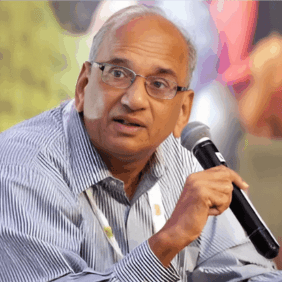
G. CHANDRASHEKHAR
Economist, Senior Editor, Policy Commentator, Commodities
Market Specialist, Independent Director on corporate boards, Independent Member, SEBI – CDAC